

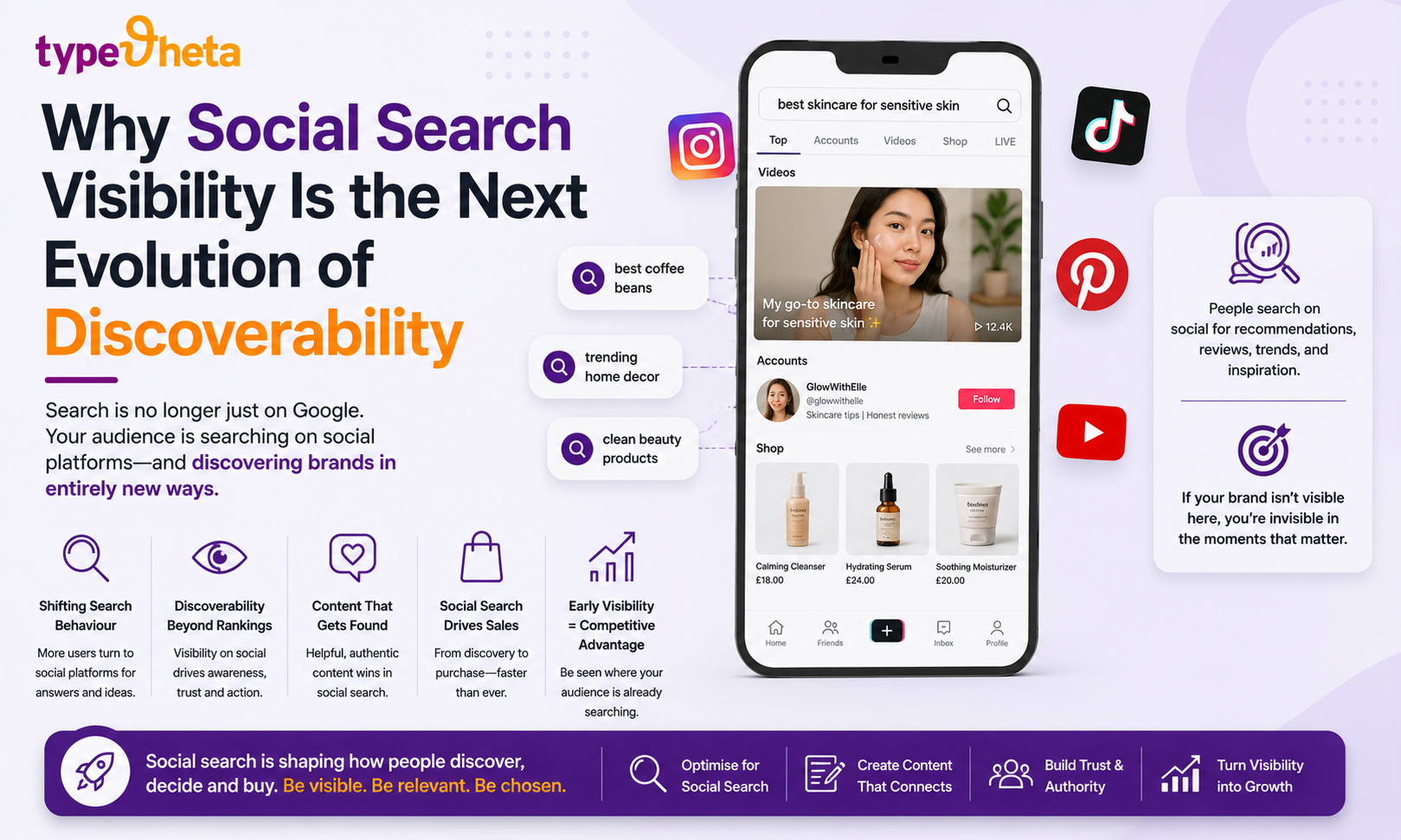
Introduction: Search Is No Longer Limited to Search Engines
For years, businesses have invested heavily in search engine optimisation to improve their rankings on Google. Whilst traditional SEO remains an essential part of digital marketing, the way people discover brands, products and services has changed dramatically.
Today’s consumers are no longer relying solely on Google to find information. Instead, they search across multiple platforms including TikTok, Instagram, YouTube, Pinterest, LinkedIn and even AI-powered assistants such as ChatGPT. This shift has created a new era of online discovery where visibility across social platforms is becoming just as important as visibility within search engines.
For ecommerce businesses, particularly Shopify stores, this change presents both a challenge and an opportunity. Brands that continue to focus only on traditional SEO risk missing valuable traffic from audiences who now begin their buying journey elsewhere. Those that optimise for social search visibility can reach potential customers earlier, build stronger brand awareness and create more opportunities to convert interest into sales.
Rather than viewing social media as simply a place to publish content, businesses should recognise it as a powerful search ecosystem that influences purchasing decisions long before a customer visits a website.
Looking for a Shopify Agency In London that understands modern search behaviour? At TypeTheta, we combine Shopify development, SEO and digital marketing strategies to help businesses improve visibility across search engines, AI platforms and social media.
What Is Social Search Visibility?
Social search visibility refers to how easily your business, products and content can be discovered through searches performed on social media platforms.
Instead of typing every query into Google, users increasingly search directly within apps where they already spend their time. Whether someone is looking for fashion inspiration on Instagram, product reviews on YouTube or business recommendations on LinkedIn, social platforms have become search engines in their own right.
Unlike traditional SEO, which focuses on ranking webpages, social search optimisation is about making your content discoverable through platform-specific search features, hashtags, keywords, captions, user engagement and creator authority.
For ecommerce brands, this means optimising every piece of content so that it can be found naturally when users search for products, solutions or inspiration.
Recommended Article: How Web Development Impacts SEO Performance of the Website
Why Search Behaviour Has Changed
Consumer behaviour has evolved significantly over the past few years.
People no longer follow a straightforward journey from Google search to website purchase. Instead, they move between multiple platforms, gathering information from various sources before making a buying decision.
Several factors have contributed to this shift.
Consumers Want Faster Answers
Modern users expect immediate, visual and easy-to-understand information.
Short-form videos, image carousels and creator recommendations often provide answers more quickly than lengthy articles or traditional search results.
Instead of reading several webpages, users can watch a thirty-second product demonstration or tutorial that answers their questions instantly.
Trust Is Built Through Real Experiences
Consumers increasingly value authentic experiences over polished advertising.
They actively search for:
- Customer reviews
- Product demonstrations
- Unboxing videos
- Before and after transformations
- Expert opinions
- User-generated content
This type of content feels more trustworthy because it comes from real people rather than promotional campaigns.
Mobile Usage Continues to Dominate
Most online searches now begin on mobile devices.
Social media platforms are designed specifically for mobile users, making them a natural starting point for discovering new products, services and brands.
The convenience of searching, watching and purchasing within the same application has accelerated this behavioural shift.
Recommended Article: How Regular Website Audits Improve SEO and Conversions
Welcome to the Era of “Search Everywhere”
The customer journey is no longer centred around a single search engine.
Instead, people search wherever they believe they will find the most useful answer.
A customer looking for a new skincare product may:
- Search Google for expert reviews.
- Watch tutorials on YouTube.
- Browse Instagram for before and after results.
- Search TikTok for honest opinions.
- Read discussions on Reddit.
- Ask ChatGPT for product recommendations.
- Visit the brand’s website before purchasing.
Each platform plays a different role in influencing the final decision.
This behaviour is often referred to as Search Everywhere, where discoverability depends on your presence across multiple digital channels rather than a single ranking on Google.
For businesses, this means visibility must extend far beyond traditional search engine optimisation.
Social Platforms Are Becoming Search Engines
Every major social platform has invested heavily in improving its search functionality.
Users now search these platforms using keywords, phrases and questions in much the same way they search Google.
Instagram users search for:
- Fashion trends
- Restaurants
- Local businesses
- Travel destinations
- Home décor inspiration
- Product recommendations
Optimised captions, alt text, hashtags, profile information and location tags all influence discoverability.
TikTok
TikTok has become one of the fastest-growing search platforms among younger audiences.
People frequently search for:
- Product reviews
- Shopping recommendations
- Tutorials
- Beauty tips
- Technology comparisons
- Business advice
Videos that include relevant spoken keywords, captions and descriptions have greater opportunities to appear in search results.
YouTube
YouTube remains one of the world’s largest search engines.
Users rely on it for:
- Product comparisons
- Buying guides
- Reviews
- Educational content
- Demonstrations
- Troubleshooting
Well-optimised video titles, descriptions and transcripts significantly improve discoverability.
For B2B businesses, LinkedIn search is becoming increasingly valuable.
Potential clients search for:
- Industry specialists
- Agencies
- Service providers
- Case studies
- Thought leadership
- Business insights
Publishing valuable content consistently improves visibility within LinkedIn’s search ecosystem.
Why Traditional SEO Alone Is No Longer Enough
Traditional SEO remains one of the strongest long-term marketing investments.
However, relying solely on Google means missing customers who begin their journey elsewhere.
Today’s consumers often discover brands before they ever perform a Google search.
For example, someone may first encounter your business through:
- An Instagram Reel
- A TikTok review
- A YouTube buying guide
- A LinkedIn article
- A recommendation from an AI assistant
Only afterwards do they search for your brand name or visit your website.
This demonstrates why discoverability now depends on building visibility across multiple platforms.
Businesses that integrate SEO with social search optimisation create significantly more opportunities to engage potential customers throughout the buying journey.
How Social Search Supports Traditional SEO
Rather than replacing SEO, social search strengthens it.
An effective digital strategy allows each channel to reinforce the others.
Benefits include:
- Increased branded searches on Google.
- Higher website traffic.
- Stronger customer trust.
- Greater brand recognition.
- More backlinks through shareable content.
- Improved engagement signals.
- Better conversion opportunities.
The more frequently customers encounter your business across different platforms, the more familiar and trustworthy your brand becomes.
This consistency plays an increasingly important role in influencing purchasing decisions.
Increase your online visibility with SEO Services In London that combine technical SEO, content strategy and social discoverability to help your business reach customers wherever they search.
Why Social Search Visibility Matters for Shopify Brands
For Shopify businesses, discoverability is directly connected to growth.
Customers rarely purchase from the first website they visit. Instead, they research products, compare brands and seek reassurance before committing to a purchase.
A strong social search presence allows your business to appear throughout this research process.
This provides several advantages:
- Increased brand awareness before customers visit your website.
- More qualified traffic from users actively researching products.
- Greater trust through educational and user-generated content.
- Higher engagement across multiple digital channels.
- Improved opportunities to convert social audiences into customers.
Businesses that invest in social search visibility today are positioning themselves for the future of ecommerce, where discoverability extends well beyond traditional search engines.
How to Improve Your Social Search Visibility
Building social search visibility requires more than publishing content regularly. Every post, video and profile should be created with discoverability in mind, making it easier for users to find your brand through platform searches.
The most successful businesses approach social platforms in the same way they approach SEO by understanding search intent, creating valuable content and consistently optimising for their audience.
Optimise Your Social Profiles
Your social media profiles are often the first impression potential customers have of your business.
Ensure each profile includes:
- A clear business description
- Relevant keywords within your bio
- Consistent branding across platforms
- A recognisable logo and imagery
- Links to your website or Shopify store
- Accurate contact information
Well-optimised profiles improve discoverability whilst reinforcing your brand identity.
Create Content Around Search Intent
People search social platforms to solve problems, answer questions and discover new ideas.
Instead of creating purely promotional content, focus on topics your audience actively searches for.
Examples include:
- How-to guides
- Product tutorials
- Frequently asked questions
- Buying guides
- Product comparisons
- Industry trends
- Customer success stories
Content that genuinely helps users is more likely to appear in search results and generate engagement.
Use Keywords Naturally
Keywords are just as important on social platforms as they are on websites.
Include relevant search terms naturally within:
- Video titles
- Captions
- Image descriptions
- Profile bios
- Hashtags where appropriate
- Spoken dialogue in videos
Avoid keyword stuffing. Focus on writing naturally whilst clearly explaining what your content is about.
Encourage User Engagement
Most social platforms reward content that generates meaningful engagement.
Encourage your audience to:
- Ask questions
- Leave comments
- Share their experiences
- Save useful posts
- Tag friends or colleagues
Higher engagement signals indicate that your content provides value, increasing its visibility within platform search results.
Platform-Specific Strategies for Better Discoverability
Each social platform has its own algorithm and search behaviour. Understanding these differences helps you optimise more effectively.
Instagram continues to prioritise searchable content.
Improve discoverability by:
- Writing descriptive captions
- Using relevant keywords naturally
- Adding location tags where appropriate
- Creating informative carousel posts
- Using alt text for images
- Publishing high-quality Reels consistently
Rather than relying solely on hashtags, focus on creating content that answers the questions your audience is searching for.
TikTok
TikTok has become one of the most influential search platforms for younger audiences.
To improve visibility:
- Mention keywords naturally within your videos
- Include keyword-rich captions
- Add descriptive text overlays
- Create educational content
- Answer commonly searched questions
- Maintain consistent publishing
TikTok increasingly indexes spoken words, making clear narration an important ranking factor.
YouTube
YouTube functions much like a traditional search engine.
Optimise your videos by:
- Writing keyword-focused titles
- Creating detailed descriptions
- Using accurate video chapters
- Adding subtitles
- Designing compelling thumbnails
- Answering specific customer questions
Long-form educational content often performs exceptionally well because it builds authority and trust.
LinkedIn is particularly valuable for B2B businesses and professional service providers.
Increase visibility by:
- Publishing industry insights
- Sharing case studies
- Writing thought leadership articles
- Participating in professional discussions
- Optimising your company page
Consistent expertise builds credibility and improves discoverability within LinkedIn search.
Grow your business with Shopify Marketing Services London that combine social media strategy, SEO and conversion-focused campaigns to help your brand reach the right audience.
The Relationship Between AI Search and Social Search
Artificial intelligence is changing how people discover businesses online.
Rather than browsing multiple websites, users increasingly ask AI-powered assistants for recommendations.
Examples include:
- Which Shopify agencies are highly recommended?
- What are the best ecommerce SEO strategies?
- Which branding agency should I choose?
- What is the best platform for starting an online store?
AI models often reference content that demonstrates authority, consistency and strong online visibility.
Businesses with active social profiles, valuable educational content and recognised expertise are more likely to be referenced within AI-generated responses.
This makes social search visibility an important part of preparing for the future of search.
Common Mistakes That Reduce Social Search Visibility
Many businesses create excellent content but struggle to achieve visibility because of avoidable mistakes.
Some of the most common include:
- Publishing without understanding search intent
- Using inconsistent branding across platforms
- Ignoring platform-specific optimisation
- Creating overly promotional content
- Posting irregularly
- Failing to engage with followers
- Neglecting video content
- Using generic captions with little context
- Ignoring analytics and performance data
Avoiding these issues helps build stronger visibility and improves long-term discoverability.
Measuring Social Search Success
Like traditional SEO, social search optimisation should be measured regularly.
Monitor key performance indicators such as:
- Profile searches
- Reach from search
- Content impressions
- Engagement rates
- Video watch time
- Website clicks
- Follower growth
- Brand mentions
- Conversion rates from social traffic
Analysing these metrics allows you to identify which content performs best and where further optimisation is required.
The Future of Discoverability
Search is continuing to evolve rapidly.
Rather than existing as separate channels, search engines, AI assistants and social platforms are becoming increasingly connected.
Customers now expect to discover brands wherever they spend their time online.
Over the coming years, businesses that invest in visibility across multiple platforms will gain a significant competitive advantage.
Future-ready brands will focus on:
- Creating genuinely helpful content
- Building authority across multiple platforms
- Maintaining consistent branding
- Optimising for AI-assisted search
- Producing engaging video content
- Strengthening customer trust
Discoverability will no longer depend on ranking well in one place. It will depend on being visible wherever your audience searches.
Best Practices for Building Long-Term Social Search Visibility
A successful strategy should focus on consistency rather than short-term trends.
Prioritise the following:
- Create content that answers customer questions.
- Optimise every profile using relevant keywords.
- Publish educational and informative content consistently.
- Repurpose content across multiple platforms.
- Monitor social search analytics regularly.
- Encourage customer-generated content and reviews.
- Invest in high-quality video content.
- Align social media strategy with your SEO strategy.
- Keep branding consistent across every channel.
- Regularly update older content with new insights.
Small, consistent improvements often produce stronger long-term results than chasing every new platform feature.
Final Thoughts
Social search visibility is no longer an emerging trend. It has become a fundamental part of how people discover businesses, products and services online.
As consumers increasingly search through Instagram, TikTok, YouTube, LinkedIn and AI-powered assistants, businesses must adapt their marketing strategies to meet changing expectations.
Traditional SEO remains essential, but it is no longer sufficient on its own.
The brands that succeed over the coming years will be those that combine technical SEO, high-quality content, social media optimisation and AI-ready strategies to create a seamless discoverability experience across every digital touchpoint.
For Shopify businesses, investing in social search visibility today means building stronger brand awareness, attracting more qualified customers and creating sustainable long-term growth.
Frequently Asked Questions
What is social search visibility?
Social search visibility is the ability of your content, products and brand to appear when users search directly within platforms such as Instagram, TikTok, YouTube, LinkedIn and Pinterest.
Why is social search becoming more important?
Consumers increasingly use social platforms to discover products, research businesses and seek recommendations before making purchasing decisions.
Does social search replace traditional SEO?
No. Social search complements traditional SEO by helping businesses reach audiences across multiple platforms and strengthening overall online visibility.
How can Shopify businesses improve social search visibility?
Focus on creating valuable content, optimising social profiles, using relevant keywords naturally, publishing consistently and aligning your social strategy with your SEO efforts.
Which platforms should businesses prioritise?
The right platforms depend on your audience. However, Instagram, TikTok, YouTube and LinkedIn currently offer significant opportunities for improving discoverability.
Does AI affect social search visibility?
Yes. AI-powered search tools increasingly reference brands that demonstrate authority, consistency and strong visibility across multiple online platforms.
Ready to Improve Your Brand’s Discoverability?
Being visible on Google is no longer enough. Today’s customers discover businesses across search engines, social media platforms and AI-powered assistants before they ever visit a website.
At TypeTheta, we help businesses build a future-ready digital presence through expert SEO Services, Shopify Development Services, Shopify Marketing Services in London and strategic branding solutions.
Whether you’re looking to improve your Shopify store, increase your social search visibility or prepare your business for the future of AI-powered search, our team can develop a tailored strategy that helps your brand stand out wherever your customers are searching.
Speak to TypeTheta today and discover how we can help your business build stronger discoverability, attract qualified traffic and achieve sustainable digital growth.