

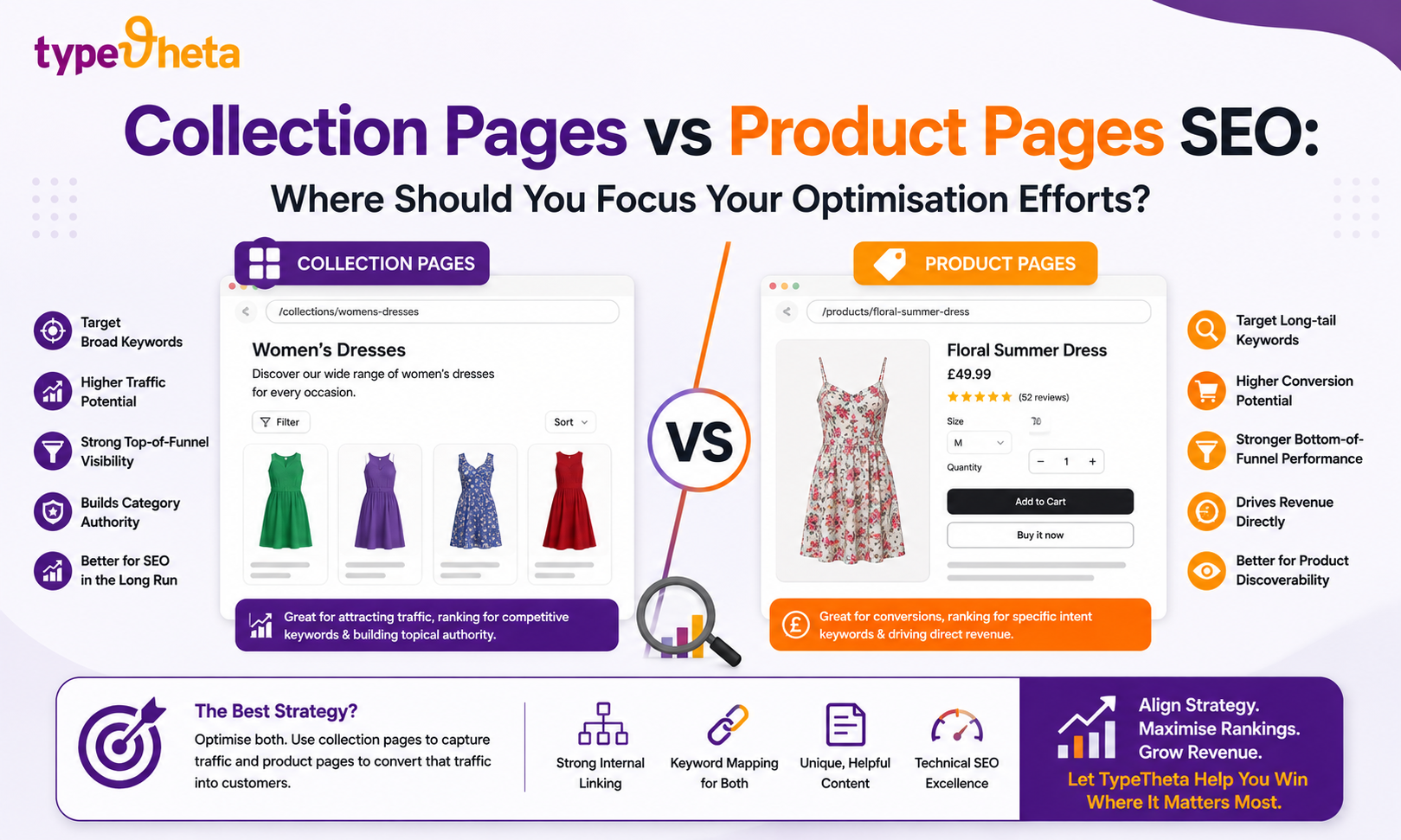
Introduction: Why Choosing the Right SEO Focus Matters
One of the most common questions ecommerce businesses ask is whether they should invest more time optimising collection pages or product pages. Whilst both play an important role in driving organic traffic and online sales, they serve different purposes within your website and support customers at different stages of the buying journey.
For Shopify merchants and ecommerce brands, deciding where to focus your SEO efforts can significantly influence your search visibility, rankings and long-term growth. Investing in the wrong areas may result in missed opportunities, whilst a well-planned SEO strategy can help your store attract qualified traffic and convert more visitors into customers.
Search engines have become increasingly sophisticated in understanding search intent. Rather than simply matching keywords, they evaluate how well a page satisfies the user’s needs. This means your website structure, content hierarchy and internal linking strategy all contribute to your SEO performance.
The good news is that you do not need to choose one page type and ignore the other. Instead, the goal is to understand which pages deserve priority and how both can work together to create a scalable ecommerce SEO strategy.
Looking for expert Shopify Development Services In London? We build high-performing Shopify stores with SEO-friendly site architecture, optimised collection pages and conversion-focused product pages that help businesses grow organically.
Understanding the Difference Between Collection Pages and Product Pages
Before deciding where to focus your optimisation efforts, it is important to understand the purpose of each page type.
What Is a Collection Page?
A collection page, sometimes referred to as a category page, groups together products that share a common theme, purpose or category.
Rather than promoting a single product, collection pages help customers browse multiple options before making a purchasing decision.
Examples include:
- Men’s Running Shoes
- Women’s Summer Dresses
- Organic Skincare Products
- Wireless Earbuds
- Office Chairs
Collection pages allow customers to compare products, apply filters and explore different options without needing to perform another search.
Characteristics of Collection Pages
Well-optimised collection pages typically:
- Target broader commercial keywords
- Group related products together
- Include filtering and sorting functionality
- Improve website navigation
- Help search engines understand your website structure
- Support internal linking throughout your store
Collection pages are designed to capture customers who are still researching and comparing products.
What Is a Product Page?
A product page focuses on a single product or product variation.
These pages provide detailed information that helps customers make a purchasing decision.
Examples include:
- Nike Air Zoom Pegasus 41
- Ergonomic Office Chair with Adjustable Lumbar Support
- Organic Vitamin C Facial Serum 500ml
Unlike collection pages, product pages are highly specific and target users with stronger purchasing intent.
Characteristics of Product Pages
An effective product page usually includes:
- Unique product descriptions
- Product specifications
- Pricing information
- High-quality images
- Customer reviews
- Stock availability
- Frequently asked questions
- Clear call-to-action buttons
Whilst collection pages encourage discovery, product pages focus on conversion.
Understanding Search Intent
One of the biggest reasons collection pages outperform product pages in search results is search intent.
Google’s primary objective is to provide users with the page that best answers their query.
When someone searches for:
- Running Shoes
- Coffee Machines
- Office Furniture
they are usually looking to compare options.
Google understands this behaviour and is more likely to rank a category or collection page than an individual product.
However, when someone searches for:
- Nike Air Zoom Pegasus 41 Size 9
- Sage Barista Express Coffee Machine
- Herman Miller Aeron Chair
their intent is much more specific.
In these cases, product pages become the most relevant result.
Understanding this difference allows businesses to optimise the right pages for the right keywords.
Why Collection Pages Should Be Your Primary SEO Focus
For most ecommerce websites, collection pages generate the greatest long-term SEO value.
Rather than targeting one product, they can rank for dozens or even hundreds of relevant search terms whilst supporting every product beneath them.
They Target High-Volume Commercial Keywords
Collection pages naturally target broader keywords with significantly higher search volumes.
Instead of focusing on a single product, they cover an entire category.
For example:
A collection page targeting Women’s Running Shoes has the potential to rank for searches such as:
- Best women’s running shoes
- Women’s trainers
- Running shoes for women
- Lightweight running shoes
- Trail running shoes
- Running footwear
A single well-optimised collection page can attract visitors from numerous related search queries.
This broader keyword targeting increases your opportunities to capture customers during the early stages of their buying journey.
They Match How Customers Search
Most online shoppers do not begin with an exact product in mind.
Instead, they search using broader commercial phrases before narrowing their options.
Typical customer searches include:
- Best gaming laptops
- Leather handbags
- Dining tables
- Garden furniture
- Standing desks
These searches indicate that users want to compare products rather than purchase immediately.
Collection pages satisfy this intent by displaying multiple relevant products in one location.
Because they align naturally with user behaviour, Google often rewards them with stronger rankings.
They Build Topical Authority
Topical authority has become one of the strongest ranking signals in modern SEO.
Search engines reward websites that demonstrate expertise across an entire subject rather than focusing on isolated keywords.
Collection pages help establish this authority by bringing related products together within a single topic.
For example, a Wireless Headphones collection may naturally include content covering:
- Noise-cancelling headphones
- Bluetooth headphones
- Sports headphones
- Over-ear headphones
- Wireless earbuds
This creates a comprehensive resource that signals expertise to search engines.
Over time, your website develops stronger relevance for the entire topic rather than individual products alone.
They Support Semantic SEO
Modern SEO is no longer about repeating the same keyword.
Google understands context, relationships and user intent.
Collection pages naturally include related products, complementary terms and supporting content that strengthens semantic relevance.
Instead of targeting a single keyword repeatedly, they allow you to incorporate:
- Related product types
- Synonyms
- Customer questions
- Buying considerations
- Supporting categories
This broader context improves your ability to rank for multiple search variations.
They Strengthen Your Website Architecture
Collection pages sit near the top of your ecommerce hierarchy.
They connect categories with individual products, making them essential for both customers and search engines.
A strong site architecture helps Google:
- Discover new pages more efficiently
- Understand relationships between products
- Crawl your website more effectively
- Distribute authority throughout your site
Without well-structured collection pages, product pages often become isolated and receive less internal authority.
They Improve Internal Linking
Internal linking remains one of the most powerful yet underused SEO strategies.
Collection pages naturally function as central hubs that pass authority throughout your website.
An effective collection page links to:
- Every relevant product
- Related collections
- Buying guides
- Informational blog content
- Seasonal landing pages
This improves crawlability whilst helping customers navigate your website more easily.
The result is stronger rankings, better user engagement and improved conversion opportunities.
They Improve User Experience
User experience is closely connected to SEO performance.
Collection pages make browsing easier by allowing customers to:
- Compare products
- Filter by price
- Sort by popularity
- Refine results
- Discover alternatives
Instead of forcing visitors to return to search results repeatedly, collection pages keep them engaged within your website.
This often leads to:
- Lower bounce rates
- Longer session durations
- More page views
- Higher engagement
- Improved conversion opportunities
These behavioural signals reinforce your website’s quality and relevance.
Increase your online visibility with SEO Services In London designed to improve your Shopify store’s architecture, collection pages and organic search performance for sustainable long-term growth.
Collection Pages Scale More Efficiently Than Product Pages
One of the greatest advantages of optimising collection pages is scalability.
Unlike product pages, which require individual optimisation, a single collection page can improve the visibility of dozens or even hundreds of products.
Every improvement you make to a collection page has the potential to benefit an entire category rather than a single item.
Why Scalability Matters
As your Shopify store grows, managing hundreds or thousands of product pages becomes increasingly time-consuming.
Collection pages provide a far more efficient approach because they:
- Target multiple related keywords
- Support entire product categories
- Improve the visibility of linked products
- Consolidate SEO authority into one destination
This makes them one of the highest return-on-investment areas for ecommerce SEO.
Why Product Pages Still Matter
Although collection pages should generally receive greater SEO attention, product pages remain an essential part of your ecommerce strategy.
Once customers have discovered your products through a collection page, product pages provide the detailed information needed to complete a purchase.
Without well-optimised product pages, even the strongest collection page will struggle to generate revenue.
Product Pages Capture High-Intent Searches
Product pages are designed for customers who already know what they want.
These users often search using:
- Brand names
- Product models
- Colours
- Sizes
- Technical specifications
- Product features
For example:
- Nike Air Zoom Pegasus 41 Size 10
- White Oak Dining Table 180cm
- Wireless Bluetooth Noise Cancelling Headphones
These searches demonstrate strong purchase intent, making product pages highly valuable for conversions.
Product Pages Drive Revenue
Whilst collection pages introduce customers to your product range, product pages are where purchasing decisions are made.
A high-converting product page should include:
- Unique product descriptions
- High-quality images
- Technical specifications
- Customer reviews
- Delivery information
- Returns policy
- Frequently asked questions
- Trust badges
- Clear pricing
- Strong calls to action
Every element should reduce uncertainty and encourage customers to complete their purchase.
Product Pages Support the Wider SEO Strategy
Product pages also strengthen your overall SEO ecosystem.
When linked effectively from collection pages, buying guides and blog articles, they benefit from additional authority and increased crawlability.
Although they rarely rank for broad commercial keywords, they perform exceptionally well for transactional and long-tail searches.
Collection Pages vs Product Pages: Which Should You Prioritise?
If your goal is sustainable organic growth, collection pages should form the foundation of your ecommerce SEO strategy.
They consistently deliver greater long-term value because they:
- Target broader search terms
- Attract higher search volumes
- Build topical authority
- Strengthen website architecture
- Improve internal linking
- Scale efficiently as your catalogue grows
However, this does not mean product pages should be neglected.
Both page types serve different purposes and work together throughout the customer journey.
A Balanced SEO Strategy Delivers the Best Results
Rather than choosing one over the other, prioritise your optimisation efforts in the following order.
First, optimise your collection pages by:
- Targeting broad and mid-tail keywords
- Writing unique category content
- Improving navigation and filtering
- Enhancing internal linking
- Adding frequently asked questions where appropriate
Then optimise your product pages by:
- Targeting long-tail keywords
- Creating unique product descriptions
- Improving image optimisation
- Adding structured data
- Displaying customer reviews and trust signals
This layered approach allows each page type to perform its intended role while supporting the other.
Grow your online store with Shopify Marketing Services London that combine SEO, content strategy and conversion optimisation to help your products reach the right audience.
Building an Effective Internal Linking Strategy
Internal linking is one of the most overlooked aspects of ecommerce SEO.
A well-planned internal linking structure helps search engines understand your website whilst making it easier for customers to navigate.
Link Collection Pages to Product Pages
Every collection page should link naturally to all relevant products.
This:
- Passes authority throughout your website
- Improves crawlability
- Supports product discovery
- Encourages deeper browsing
Link Product Pages Back to Collections
Product pages should also include links back to their parent collection.
This helps customers continue browsing if the current product is not the right fit.
Examples include:
- Back to Running Shoes
- View All Office Chairs
- Explore More Wireless Earbuds
These links strengthen both navigation and SEO.
Connect Related Collection Pages
Related collections should support one another through contextual internal links.
Examples include:
- Running Shoes → Sports Clothing
- Dining Tables → Dining Chairs
- Men’s Trainers → Sports Accessories
These relationships help build topical authority across your website.
Use Blog Content to Support Both Page Types
Your blog should strengthen your ecommerce SEO strategy by linking naturally to relevant collection and product pages.
For example:
Buying guides can link to collection pages.
Product comparison articles can link directly to featured products.
Educational content can connect visitors with both informational and commercial pages.
This creates a logical content ecosystem that benefits users and search engines alike.
Common SEO Mistakes to Avoid
Many ecommerce businesses unknowingly limit their organic growth by making avoidable SEO mistakes.
Some of the most common include:
- Using duplicate content across collection pages
- Copying manufacturer descriptions onto product pages
- Creating thin category pages with little or no content
- Neglecting internal linking
- Optimising multiple pages for the same keyword
- Allowing orphaned product pages
- Failing to update category content as product ranges evolve
Avoiding these issues strengthens your site’s authority and improves long-term search performance.
Best Practices for Shopify Collection and Product Page SEO
Successful Shopify SEO relies on continuous optimisation rather than one-off improvements.
Focus on:
- Creating descriptive, keyword-focused collection page content
- Writing unique product descriptions
- Optimising title tags and meta descriptions
- Using descriptive image alt text
- Implementing Product and Breadcrumb Schema
- Improving Core Web Vitals
- Maintaining a clear site hierarchy
- Regularly reviewing internal links
- Updating collection pages with new products and content
- Monitoring search performance through Google Search Console
Consistent optimisation helps your website remain competitive as search algorithms evolve.
Final Thoughts
Collection pages and product pages are not competing assets. They perform different but equally valuable roles within a successful ecommerce SEO strategy.
Collection pages help customers discover your products, build topical authority and generate scalable organic traffic.
Product pages provide the detailed information and trust signals needed to convert that traffic into paying customers.
For most Shopify stores, the smartest approach is to build a strong SEO foundation through well-optimised collection pages before refining individual product pages.
When supported by strategic internal linking, high-quality content and a logical site structure, both page types work together to improve rankings, increase qualified traffic and drive sustainable business growth.
Frequently Asked Questions
Are collection pages better for SEO than product pages?
In most cases, yes. Collection pages target broader commercial keywords, attract more organic traffic and build stronger topical authority, making them the primary focus for ecommerce SEO.
Should product pages still be optimised?
Absolutely. Product pages capture high-intent searches and play a crucial role in converting visitors into customers.
Can product pages rank for broad keywords?
Generally, no. Broad keywords usually favour collection or category pages because they better satisfy users looking to compare multiple products.
Do collection pages need unique content?
Yes. Every collection page should include original, keyword-optimised content that explains the category and helps both users and search engines understand its purpose.
How often should collection pages be updated?
Review collection pages regularly by adding new products, refreshing content, updating internal links and ensuring keywords remain relevant to current search trends.
Is this SEO strategy suitable for Shopify stores?
Yes. Shopify stores benefit significantly from prioritising collection page SEO whilst maintaining well-optimised product pages that support conversions and long-tail keyword visibility.
Ready to Improve Your Shopify SEO Strategy?
A successful ecommerce website requires more than attractive product pages. It needs a well-structured SEO strategy that helps customers discover your products and guides them towards conversion.
At TypeTheta, our Shopify Agency In London specialises in building SEO-friendly Shopify stores that combine intelligent site architecture, high-performing collection pages and optimised product pages to maximise organic growth.
Whether you need expert Shopify Development Services, results-driven SEO Services, strategic Shopify Marketing Services in London or professional branding solutions, our team can help you build a scalable ecommerce strategy designed for long-term success.
Speak to TypeTheta today and discover how our Shopify specialists can help your business improve search visibility, increase qualified traffic and generate more online sales.