

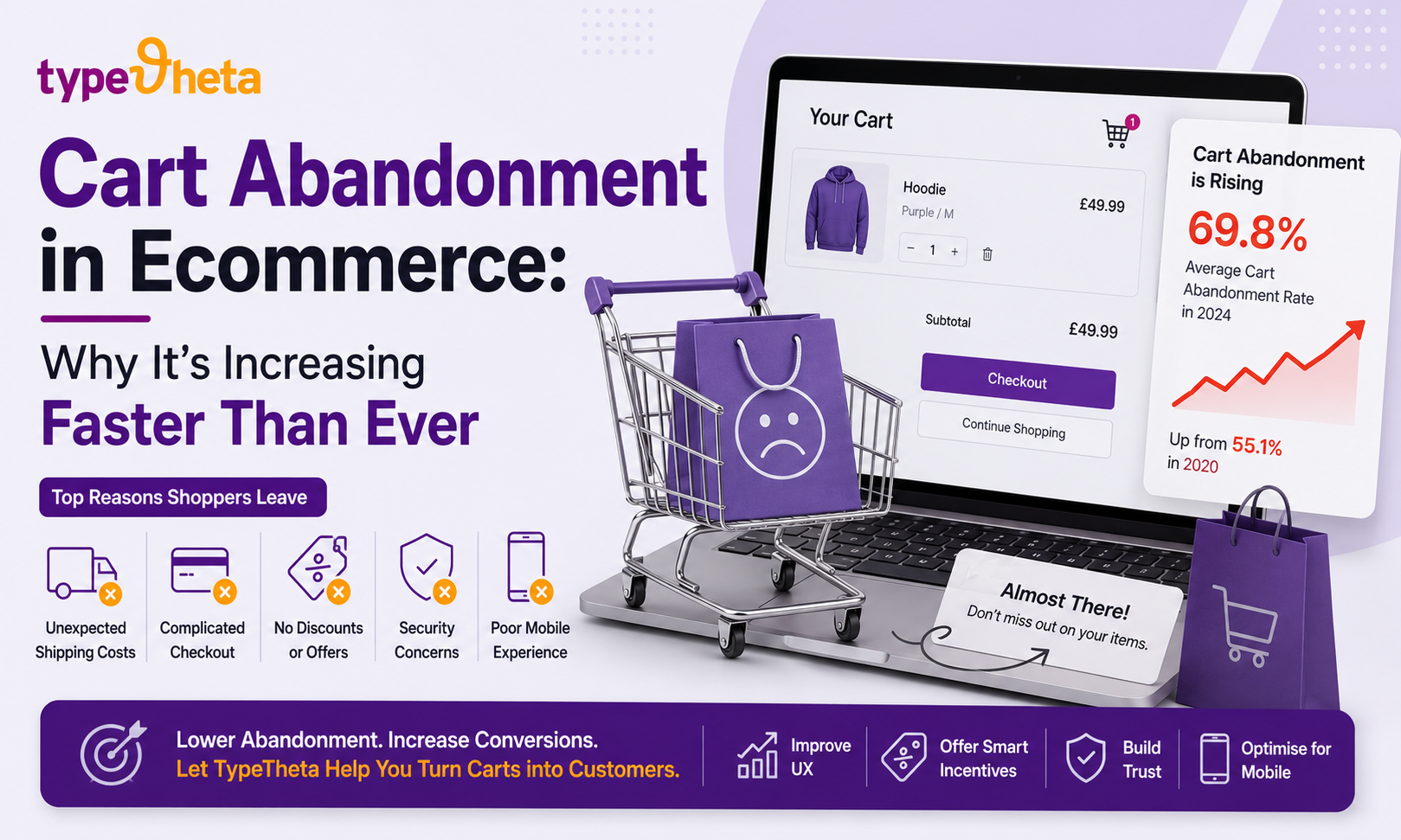
Introduction: Why Cart Abandonment Is Becoming a Bigger Challenge for Ecommerce Businesses
Every ecommerce business shares the same goal: turning website visitors into paying customers. Yet one of the biggest obstacles to achieving consistent growth remains cart abandonment in ecommerce.
Although shoppers abandoning their baskets is not a new phenomenon, the way customers behave has changed dramatically. In 2026, consumers make purchasing decisions faster than ever before, expect seamless online experiences and have countless alternatives available within seconds. A minor inconvenience that may once have been overlooked can now result in an immediate exit from your website.
For Shopify merchants, this shift presents both a challenge and an opportunity. Whilst higher abandonment rates can significantly impact revenue, businesses that understand modern customer behaviour can optimise their stores to recover more sales and improve conversion rates.
Today’s online shoppers no longer complete their buying journey on a single device or platform. They may discover your product on Instagram, compare prices on Google, ask AI-powered search tools for recommendations, read reviews on Reddit, watch demonstrations on YouTube and only then decide whether to complete a purchase.
This evolving customer journey means reducing cart abandonment is no longer simply about improving your checkout page. It requires creating a fast, transparent and trustworthy shopping experience from the very first interaction.
Looking for experienced Shopify Development Services In London? Our Shopify experts build high-performing ecommerce stores with streamlined checkout experiences, mobile-first design and conversion-focused features that help businesses reduce cart abandonment and increase online sales.
What Is Cart Abandonment in Ecommerce?
Cart abandonment occurs when a customer adds one or more products to their online shopping basket but leaves the website before completing the purchase.
Although some customers return later, many never come back, resulting in lost revenue for the business.
Cart abandonment is measured by comparing completed purchases against shopping baskets created during the customer journey.
Why It Matters
Every abandoned basket represents a customer who showed genuine buying intent.
They:
- Found your products
- Explored your website
- Added items to their basket
- Considered making a purchase
However, something prevented them from completing the transaction.
Understanding what caused that hesitation is essential for improving your conversion rate.
The Current State of Cart Abandonment in Ecommerce
Industry research consistently shows that approximately 70% of online shopping baskets are abandoned before checkout is completed.
Whilst this figure varies depending on industry, device and customer type, it highlights one important reality:
Most ecommerce businesses are losing significantly more potential customers than they realise.
Several factors have accelerated this trend.
Mobile Shopping Dominates
More than ever, customers browse and shop using smartphones.
Whilst mobile commerce has grown rapidly, many ecommerce websites still provide a desktop-first experience, leading to:
- Difficult navigation
- Slow-loading pages
- Complicated checkout forms
- Poor payment experiences
Even a few seconds of frustration can result in customers abandoning their purchase.
Customers Expect Instant Experiences
Consumers have become accustomed to frictionless digital experiences provided by companies such as Amazon, Apple and leading ecommerce brands.
These expectations now apply to every online store.
Customers expect:
- Fast-loading websites
- Simple navigation
- One-page checkout
- Multiple payment methods
- Transparent pricing
- Immediate trust signals
If your Shopify store fails to meet these expectations, customers will often leave before completing their purchase.
Revenue Is Often Recoverable
The positive news is that abandoned baskets are not always lost forever.
Many customers simply need reassurance, additional information or a reminder to return.
Businesses that optimise the customer journey and implement effective recovery strategies can recover a significant percentage of abandoned sales.
Why Customer Behaviour Has Changed
One of the biggest reasons cart abandonment continues to rise is that customers shop differently than they did just a few years ago.
Today’s consumers are informed, impatient and highly selective.
Rather than making immediate purchasing decisions, they research extensively before committing.
Several behavioural changes are driving this trend.
Faster Decision Making
Customers form opinions about an ecommerce website within seconds.
If anything creates uncertainty, confusion or delay, they simply leave.
Common triggers include:
- Slow website speed
- Complicated navigation
- Unexpected pop-ups
- Poor mobile usability
- Missing product information
Unlike previous years, customers rarely wait for problems to resolve themselves.
Search Everywhere Behaviour
Modern consumers rarely purchase after a single Google search.
Instead, they search across multiple platforms before making a decision.
Their journey may include:
- Google Search
- Google AI Mode
- ChatGPT Shopping
- TikTok
- YouTube
- Trustpilot
- Product comparison websites
This behaviour delays purchasing decisions and increases the likelihood of abandoned baskets.
Businesses must now build trust across multiple channels rather than relying solely on their website.
Lower Brand Loyalty
Customers are increasingly willing to switch brands if they discover:
- Better pricing
- Faster delivery
- More positive reviews
- Better returns policies
- Stronger social proof
Loyalty is earned through customer experience rather than brand recognition alone.
Mobile First Expectations
Most ecommerce traffic now comes from mobile devices.
Customers expect the same quality of experience they receive from native mobile applications.
Anything less than a smooth mobile experience can quickly lead to abandonment.
AI Is Influencing Purchase Decisions
Artificial intelligence is changing how customers shop online.
Rather than searching manually, many shoppers now ask AI assistants questions such as:
- Which Shopify store offers the best value?
- Which product has the best reviews?
- Is this website trustworthy?
- What’s the best alternative?
This means your ecommerce store must be optimised not only for Google Search but also for AI-powered search experiences.
Increase your online visibility with SEO Services In London designed to improve rankings across traditional search engines and emerging AI-powered search platforms.
The 7 Biggest Reasons for Cart Abandonment in Ecommerce
1. Unexpected Costs at Checkout
Unexpected charges remain the leading cause of cart abandonment.
Customers may happily add products to their basket only to abandon the purchase when they discover:
- Shipping costs
- VAT
- Service fees
- Import charges
- Unexpected taxes
These additional costs disrupt customer expectations and reduce trust.
How to Reduce This Problem
Improve pricing transparency by:
- Showing delivery costs early
- Displaying estimated taxes
- Offering free delivery thresholds
- Automatically applying promotional discounts
- Clearly explaining any additional fees
Customers are far more likely to complete their purchase when there are no surprises during checkout.
2. Complicated Checkout Processes
A lengthy checkout process creates unnecessary friction.
Every additional step increases the likelihood of customers leaving your website.
Common checkout frustrations include:
- Mandatory account creation
- Long forms
- Too many checkout pages
- Limited payment methods
- Poor mobile usability
Best Practice
Simplify your checkout by:
- Offering guest checkout
- Reducing unnecessary form fields
- Enabling address autofill
- Providing express checkout options such as Shop Pay, Apple Pay and Google Pay
- Optimising every step for mobile users
A streamlined checkout experience not only reduces abandonment but also improves customer satisfaction.
3. Lack of Trust and Credibility
Trust is one of the most influential factors in ecommerce purchasing decisions.
New customers are particularly cautious when buying from unfamiliar brands.
If your website lacks credibility, shoppers are unlikely to complete their purchase.
Common trust issues include:
- Missing customer reviews
- No secure payment indicators
- Poor website design
- Unclear returns policies
- Limited company information
Building Customer Confidence
Trust can be strengthened by displaying:
- Verified customer reviews
- Secure payment badges
- Clear refund policies
- Contact information
- Professional branding
- Social proof
A professional online presence begins with a trusted Shopify Agency In London that understands how design, usability and customer confidence work together to increase conversions.
Limited Payment Options Create Unnecessary Friction
Customers expect flexibility when paying online. If their preferred payment method is unavailable, many will abandon their purchase rather than look for an alternative.
As digital wallets, Buy Now Pay Later services and one-click payment solutions become more popular, ecommerce businesses that offer only traditional card payments risk losing customers at the final stage of the buying journey.
Common Payment Issues
Customers are more likely to abandon their basket when they encounter:
- Limited debit or credit card support
- No Apple Pay or Google Pay
- No Shop Pay or PayPal
- No Buy Now Pay Later options
- Payment gateway errors
How to Improve the Payment Experience
Providing customers with multiple secure payment methods increases confidence and makes checkout faster.
Best practices include:
- Supporting Apple Pay, Google Pay and Shop Pay
- Offering PayPal alongside card payments
- Including flexible payment solutions where appropriate
- Displaying secure payment icons throughout checkout
- Testing payment gateways regularly to prevent failed transactions
A flexible payment experience removes friction and encourages customers to complete their purchase.
Delivery Expectations Continue to Rise
Delivery is no longer simply a fulfilment process. It has become a major conversion factor.
Modern shoppers expect clear delivery estimates, multiple shipping options and regular tracking updates.
When delivery information is unclear or slower than expected, customers often decide not to complete their purchase.
What Today’s Customers Expect
Customers increasingly look for:
- Estimated delivery dates before checkout
- Express delivery options
- Real-time tracking updates
- Transparent delivery costs
- Easy returns and exchanges
Meeting these expectations helps reduce uncertainty and improves customer confidence.
Optimising the Delivery Experience
Businesses can reduce cart abandonment by:
- Showing delivery estimates on product pages
- Providing multiple shipping options
- Sending automated dispatch and delivery notifications
- Clearly explaining any delivery delays
- Offering an easy-to-understand returns process
Customers are far more likely to complete a purchase when they know exactly when their order will arrive.
Poor Mobile Experiences Continue to Drive Cart Abandonment
Most ecommerce traffic now comes from mobile devices, yet many online stores still fail to deliver an excellent mobile experience.
Small usability issues that may seem insignificant on desktop often become major barriers on smartphones.
Common Mobile Problems
Mobile shoppers frequently experience:
- Slow-loading pages
- Difficult navigation
- Small buttons
- Long checkout forms
- Poor page layouts
- Complicated product filtering
Each of these issues increases the likelihood of customers abandoning their shopping basket.
How to Optimise Your Shopify Store for Mobile
Improving mobile usability should be a priority for every ecommerce business.
Focus on:
- Faster page loading times
- Responsive design
- Larger call-to-action buttons
- Simplified navigation
- Streamlined checkout forms
- Mobile-friendly payment options
Even small improvements in mobile performance can lead to measurable increases in conversion rates.
Comparison Shopping Has Become the New Normal
Today’s shoppers rarely purchase immediately.
Instead, they compare products, prices, reviews and delivery options across multiple websites before making a final decision.
This behaviour has become significantly more common with the rise of AI-powered search tools, price comparison websites and social commerce.
Why Customers Leave to Compare
Customers often leave your website to:
- Compare prices
- Read customer reviews
- Check delivery options
- Look for discount codes
- Research your competitors
Whilst many intend to return, a significant number never do.
How to Stay Competitive
Reduce comparison-driven abandonment by:
- Highlighting your unique selling points
- Displaying customer reviews
- Offering transparent pricing
- Creating compelling product descriptions
- Using limited-time offers responsibly
- Demonstrating clear value beyond price
Customers who understand why your business is different are less likely to continue shopping elsewhere.
Grow your Shopify store with Shopify Marketing Services London that help attract qualified visitors, increase conversions and build long-term customer loyalty.
Search Everywhere Behaviour Is Reshaping Ecommerce
One of the biggest changes affecting ecommerce today is the rise of “Search Everywhere” behaviour.
Customers no longer rely solely on Google before making a purchase.
Instead, they research products across multiple platforms before deciding where to buy.
Modern Shopping Journeys Include
- Google Search
- Google AI Mode
- ChatGPT Shopping
- TikTok
- YouTube
- Customer review platforms
- Online communities
Purchasing decisions are now influenced by information gathered across several touchpoints rather than a single website visit.
For Shopify businesses, this means brand visibility must extend well beyond traditional search results.
Why Cart Abandonment Happens Faster Than Ever
Customers are not simply abandoning more shopping baskets.
They are abandoning them much earlier in the buying journey.
This change is driven by:
- Higher expectations
- Greater competition
- AI-assisted product discovery
- Faster internet speeds
- Shorter attention spans
- Increased consumer choice
If your Shopify store creates even a small amount of friction, customers can quickly move to a competitor.
Creating an exceptional first impression has never been more important.
How to Reduce Cart Abandonment in Ecommerce
Reducing cart abandonment requires continuous optimisation rather than one-off improvements.
The most successful Shopify businesses regularly review customer behaviour, analyse checkout performance and refine every stage of the buying journey.
Simplify the Checkout Process
Remove unnecessary friction by:
- Offering guest checkout
- Reducing the number of checkout steps
- Enabling address autofill
- Supporting one-click payment options
Increase Pricing Transparency
Build customer confidence by:
- Displaying delivery costs early
- Showing taxes clearly
- Explaining any additional charges
- Offering free delivery thresholds where possible
Build Trust Throughout the Journey
Customers buy from businesses they trust.
Increase credibility by including:
- Customer reviews
- Secure payment badges
- Professional branding
- Clear returns policies
- Visible contact information
Build a memorable online experience with a trusted Branding Agency In London that helps businesses create stronger customer relationships through consistent and professional brand identity.
Optimise Website Performance
Fast websites convert better.
Regularly monitor:
- Core Web Vitals
- Page loading speed
- Mobile usability
- Checkout performance
- Broken links
- Technical SEO
Recover Abandoned Shopping Baskets
Not every abandoned basket represents a lost sale.
Implement recovery strategies such as:
- Automated email reminders
- SMS follow-ups
- Retargeting campaigns
- Personalised discount offers
- Exit-intent pop-ups where appropriate
Recovering even a small percentage of abandoned baskets can significantly increase overall revenue.
Final Thoughts
Cart abandonment in ecommerce is no longer simply a checkout problem. It reflects how modern customers interact with online businesses.
As shopping journeys become increasingly influenced by AI-powered search, social commerce and cross-platform research, Shopify merchants must focus on delivering fast, transparent and trustworthy experiences from the very first interaction.
Reducing friction, improving usability and building customer confidence will not only lower abandonment rates but also increase conversions, strengthen customer loyalty and support long-term business growth.
Businesses that continually optimise their ecommerce experience will be best positioned to succeed in an increasingly competitive digital marketplace.
Frequently Asked Questions
What is cart abandonment in ecommerce?
Cart abandonment occurs when a customer adds products to an online shopping basket but leaves the website before completing their purchase.
Why is cart abandonment increasing?
Customers have higher expectations, shorter attention spans and more opportunities to compare products across multiple platforms. Even minor friction during the buying journey can lead to abandonment.
What is considered a good cart abandonment rate?
Although the average cart abandonment rate is around 70%, businesses should focus on continuous improvement rather than aiming for a specific benchmark.
How can Shopify stores reduce cart abandonment?
Improving checkout speed, offering guest checkout, displaying transparent pricing, supporting multiple payment methods and building customer trust are among the most effective strategies.
Does mobile optimisation affect cart abandonment?
Yes. Since most ecommerce traffic now comes from mobile devices, a poor mobile experience can significantly increase abandonment rates.
Can abandoned shopping baskets be recovered?
Yes. Automated email campaigns, SMS reminders, retargeting adverts and personalised follow-ups can help recover a significant proportion of abandoned baskets.
Ready to Reduce Cart Abandonment and Increase Shopify Sales?
Every abandoned basket represents an opportunity to improve your ecommerce experience and recover lost revenue. At TypeTheta, we help businesses build high-performing Shopify stores that are designed to convert visitors into loyal customers.
Whether you need a Shopify Agency, expert Shopify Development Services , results-driven Shopify Marketing Services , or SEO Services In London to increase qualified traffic, our team delivers tailored solutions that support sustainable ecommerce growth.
Speak to TypeTheta today and discover how we can help you reduce cart abandonment, improve conversions and build a Shopify store that performs better at every stage of the customer journey.