

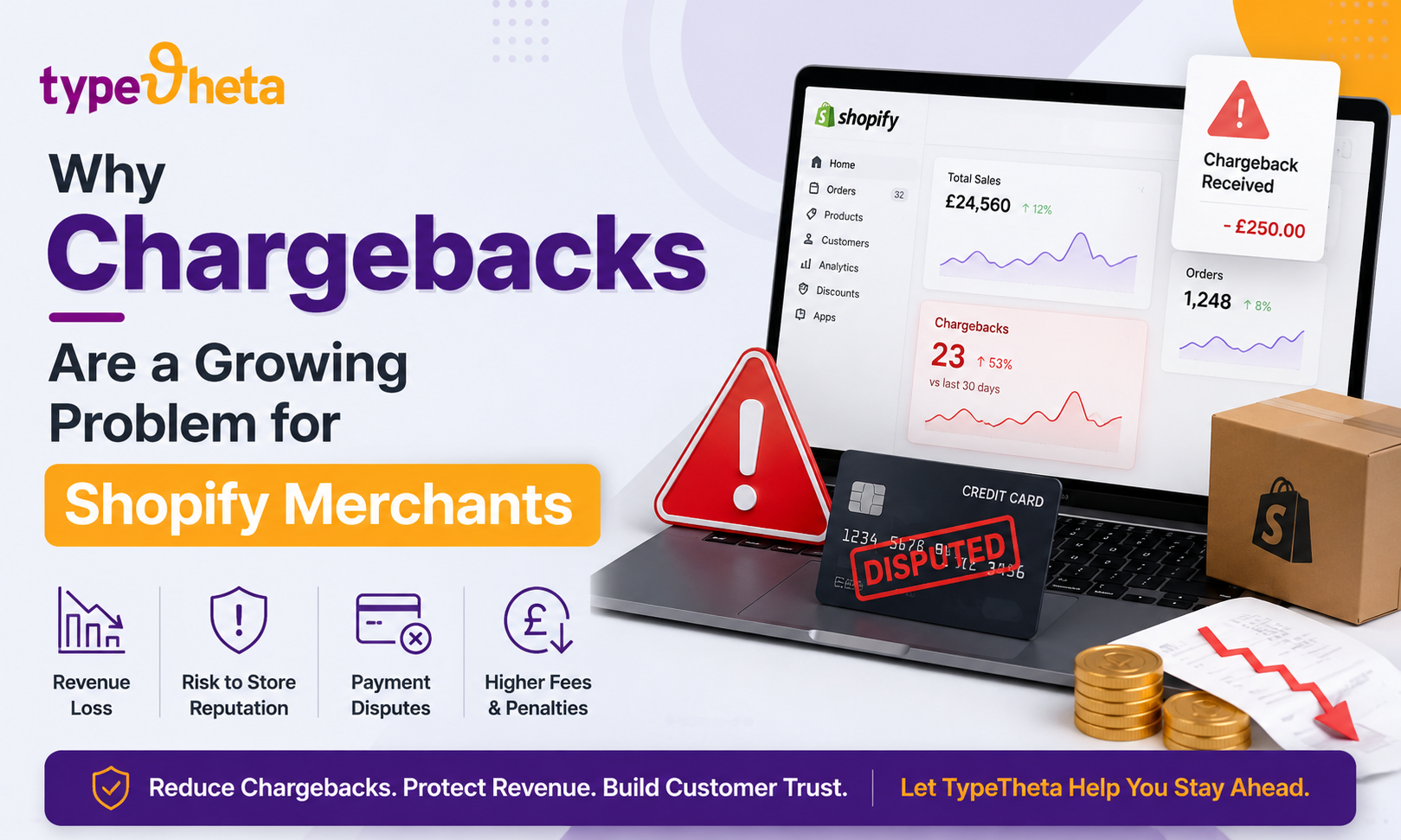
Introduction: Why Shopify Chargebacks Are Becoming a Bigger Challenge
Running a successful Shopify store involves far more than attracting visitors and generating sales. Every order placed on your website represents trust between your business and your customers. However, when that trust breaks down, it can lead to one of the biggest challenges facing ecommerce businesses today: Shopify chargebacks.
With online shopping continuing to grow throughout 2026, payment disputes have become increasingly common. Higher order volumes, cross-border transactions and more sophisticated fraud tactics mean that Shopify merchants are under greater scrutiny from payment providers and card networks than ever before.
A chargeback is far more than a refunded order. It creates a ripple effect that can damage your business in several ways, including:
- Losing both the payment and the product
- Paying additional chargeback and processing fees
- Increasing your chargeback ratio, which may lead to payment restrictions
- Damaging customer confidence and your brand reputation
- Spending valuable time managing disputes instead of growing your business
For many businesses, recurring chargebacks are not simply bad luck. They are often symptoms of operational issues such as unclear product information, poor communication, weak fraud prevention or inconsistent customer support.
The encouraging news is that most chargebacks can be prevented. By understanding the most common causes and implementing the right processes, Shopify merchants can reduce disputes, improve customer satisfaction and protect long-term profitability.
Looking for experienced Shopify Development Services In London? Our team builds secure, high-performing Shopify stores with advanced fraud prevention, seamless checkout experiences and scalable ecommerce solutions designed to help your business grow.
What Is a Shopify Chargeback?
A Shopify chargeback occurs when a customer contacts their bank or card provider to dispute a payment instead of resolving the issue directly with the merchant.
Rather than requesting a refund from your business, the customer asks their bank to reverse the transaction. During the investigation, the payment is temporarily removed from your account while the card issuer reviews the evidence submitted by both parties.
Although chargebacks exist to protect consumers from fraudulent transactions, they can create significant financial and operational challenges for legitimate Shopify merchants.
Common Reasons for Shopify Chargebacks
The most frequent reasons include:
- Unauthorised or fraudulent transactions
- Goods not received
- Products not matching their description
- Duplicate or incorrect payments
- Subscription or recurring payment confusion
- Processing errors
- Delivery disputes
Each of these situations requires merchants to provide evidence proving that the transaction was genuine.
Why Are Shopify Chargebacks So Difficult to Win?
Many merchants assume that providing proof of purchase is enough to overturn a chargeback. Unfortunately, that is rarely the case.
Banks generally prioritise protecting cardholders, meaning merchants must present detailed evidence to demonstrate that the order was legitimate.
Successful evidence may include:
- Order confirmation emails
- Delivery tracking information
- Signed proof of delivery
- Customer communication history
- Billing and shipping verification
- Device and IP address information
- Payment authorisation records
Without comprehensive documentation, even genuine sales may result in lost disputes.
Understanding why chargebacks occur is the first step towards preventing them altogether.
1. Relying on Weak Fraud Prevention Measures
The Mistake
Many Shopify merchants assume the platform’s default fraud filters provide sufficient protection.
Whilst Shopify includes useful fraud analysis tools, relying exclusively on automated checks leaves businesses vulnerable to increasingly sophisticated fraudulent activity.
Why It Matters
Fraud remains one of the leading causes of Shopify chargebacks.
Criminals now use stolen payment cards, fake identities, VPNs and automated purchasing software to bypass basic fraud detection systems.
When fraudulent transactions succeed, customers often report them as unauthorised payments, creating disputes that merchants rarely win.
The financial impact extends beyond the lost sale. Businesses may also face:
- Higher payment processing costs
- Increased chargeback ratios
- Greater scrutiny from payment providers
- Potential account limitations
How to Reduce Fraud
A proactive fraud prevention strategy should include:
- Enabling Shopify’s advanced fraud analysis
- Installing trusted fraud prevention applications
- Reviewing unusually large or high-value orders manually
- Verifying mismatched billing and delivery addresses
- Monitoring high-risk countries and suspicious purchasing patterns
- Using multi-factor customer verification where appropriate
Rather than depending on a single solution, successful Shopify merchants adopt multiple layers of protection that combine automation with manual review.
Best Practice
Treat fraud prevention as an ongoing process rather than a one-time setup.
Regularly reviewing fraud reports, analysing suspicious transactions and refining your risk settings helps protect both your revenue and your customers.
2. Poor Product Descriptions That Create Unrealistic Expectations
The Mistake
Many chargebacks begin long before a product is delivered.
Vague descriptions, misleading marketing claims and low-quality product photography often create expectations that the actual product cannot meet.
Customers who feel disappointed frequently bypass your returns process and instead raise a payment dispute with their bank.
Why It Matters
“Product not as described” remains one of the most common reasons for Shopify chargebacks.
Even relatively small inconsistencies can trigger disputes, including:
- Incorrect sizing information
- Colour differences
- Missing specifications
- Poor-quality product images
- Misleading promotional language
Customers expect transparency throughout the purchasing journey. When product information appears incomplete or exaggerated, confidence quickly disappears.
How to Prevent Product-Related Chargebacks
Improve your product pages by:
- Writing detailed, accurate descriptions
- Including dimensions, materials and technical specifications
- Using multiple high-resolution images from different angles
- Providing size charts where relevant
- Showing products in real-life situations
- Avoiding unrealistic marketing claims
Every product page should answer the questions customers are most likely to ask before making a purchase.
The more informed customers are before buying, the less likely they are to dispute the transaction afterwards.
Key Insight
Excellent product pages do more than improve conversions.
They also reduce returns, minimise misunderstandings and significantly lower the risk of Shopify chargebacks.
3. Poor Shipping Communication Creates Unnecessary Disputes
The Mistake
Failing to communicate delivery times clearly is another major cause of chargebacks.
Many customers become concerned not because their parcel has been lost, but because they simply do not know where it is.
Without proactive communication, uncertainty quickly becomes frustration.
Why It Matters
“Item not received” consistently ranks among the leading causes of payment disputes.
In many cases, the parcel is still in transit.
However, if customers receive no updates regarding dispatch, courier tracking or delivery delays, they may assume the order has failed to arrive and contact their bank instead.
This often creates an avoidable chargeback.
How to Improve Delivery Communication
Provide customers with complete visibility throughout the fulfilment process by:
- Displaying realistic delivery estimates before checkout
- Sending order confirmation emails immediately
- Providing tracking details for every shipment
- Keeping customers informed about unexpected delays
- Offering easy access to delivery updates through your website
Simple communication can prevent a significant number of unnecessary disputes.
Practical Example
Imagine a customer expects delivery within three days because no estimated timeframe is shown during checkout.
If the actual delivery takes eight working days, they may believe something has gone wrong, even if your fulfilment process is operating exactly as intended.
Setting realistic expectations from the outset dramatically reduces the likelihood of payment disputes.
Want to increase sales as well as customer satisfaction? Our SEO Services In London help Shopify businesses attract the right visitors, improve user experience and build trust throughout the customer journey.
4. Complicated or Hidden Refund Policies
The Mistake
Many Shopify merchants unintentionally make their refund and returns policies difficult to find or understand. Whether the policy is hidden within the footer, written in legal jargon or contains overly restrictive conditions, customers can quickly become frustrated.
When buyers cannot find a clear route to resolve an issue, many choose the fastest alternative by contacting their bank and raising a chargeback.
Why It Matters
A confusing refund policy often results in avoidable payment disputes.
Customers expect businesses to be transparent about returns before they make a purchase. If they discover unexpected conditions after receiving their order, they are far more likely to dispute the payment rather than engage with your support team.
Not only does this increase your chargeback rate, but it can also damage customer trust and reduce repeat business.
How to Prevent Refund-Related Chargebacks
Create a refund policy that is:
- Easy to locate on every page of your website
- Written in plain, customer-friendly language
- Clear about return eligibility and timeframes
- Transparent regarding refunds, exchanges and delivery costs
- Consistent across your website, checkout and order confirmation emails
A straightforward policy reassures customers that any issues can be resolved fairly.
Best Practice
Review your returns policy regularly to ensure it reflects your current fulfilment process and complies with consumer regulations. Transparency before purchase reduces disputes after delivery.
5. Ignoring Customer Support or Responding Too Slowly
The Mistake
Customer service plays a far greater role in chargeback prevention than many merchants realise.
When customers struggle to reach your support team or wait days for a response, frustration often leads them directly to their bank.
Why It Matters
Many chargebacks occur simply because customers feel ignored.
Even when your business is willing to resolve the issue, delayed communication creates uncertainty and encourages customers to seek an immediate resolution through their card provider.
Excellent customer support can prevent disputes before they begin.
How to Improve Customer Support
Reduce chargebacks by:
- Responding to enquiries within one working day
- Providing multiple contact options including email, live chat and telephone
- Sending automatic acknowledgements for support requests
- Keeping customers informed throughout the resolution process
- Training staff to resolve complaints efficiently and professionally
Customers who feel listened to are significantly less likely to raise payment disputes.
Key Insight
Every support conversation is an opportunity to protect your revenue and strengthen customer relationships.
Build a memorable business identity with a leading Branding Agency In London that puts your customers at the centre of every interaction.
6. Failing to Collect Strong Evidence for Chargeback Disputes
The Mistake
Many Shopify merchants only begin gathering evidence once a chargeback notification arrives.
Unfortunately, by this stage, valuable information may already be unavailable.
Why It Matters
Winning a Shopify chargeback depends largely on the quality of the evidence you provide.
Submitting incomplete documentation significantly reduces your chances of a successful outcome.
Evidence Every Merchant Should Keep
Maintain detailed records including:
- Order confirmations
- Payment authorisation details
- Courier tracking information
- Proof of delivery
- Customer emails and support conversations
- Billing and shipping addresses
- IP address and device information
- Delivery timestamps
Having organised documentation allows you to respond quickly when disputes arise.
Best Practice
Create a standard process for storing transaction records rather than collecting evidence retrospectively.
The stronger your documentation, the stronger your defence.
7. Not Monitoring Chargeback Trends
The Mistake
Many businesses treat each chargeback as an isolated incident instead of identifying recurring patterns.
Why It Matters
Chargebacks provide valuable insight into operational weaknesses.
Repeated disputes linked to specific products, delivery partners or payment methods often indicate underlying issues that require attention.
Ignoring these trends allows the same problems to continue affecting your business.
How to Analyse Chargeback Data
Monitor your chargeback reports regularly and review:
- Common dispute reasons
- Frequently affected products
- Customer locations
- Payment methods
- Delivery partners
- Monthly chargeback ratios
- Customer service trends
Using this information enables continuous improvement across your ecommerce operation.
Example
If one product consistently receives “not as described” disputes, the issue may lie with inaccurate descriptions, poor imagery or product quality rather than customer behaviour.
Key Insight
Chargeback data is valuable business intelligence.
Businesses that learn from disputes continually improve their customer experience while reducing future losses.
From Shopify Development Services In London to SEO Services In London and creative branding solutions, we provide everything your business needs to grow online.
How to Build an Effective Shopify Chargeback Prevention Strategy
Reducing chargebacks requires more than fixing individual issues.
Successful Shopify merchants develop systems that prevent disputes throughout the entire customer journey.
An effective strategy focuses on four key areas.
Prevention
Reduce fraud through robust verification systems, secure payment processes and accurate product information.
Detection
Identify suspicious transactions early using fraud analysis tools and manual order reviews.
Communication
Maintain clear communication from purchase to delivery through timely updates and responsive customer support.
Continuous Improvement
Review chargeback reports regularly and use the insights to improve products, policies and operational processes.
Practical Steps Every Shopify Merchant Should Follow
To minimise chargebacks:
- Audit your customer journey from checkout to delivery.
- Improve product descriptions and imagery.
- Display refund and delivery policies prominently.
- Provide tracking information for every order.
- Respond quickly to customer enquiries.
- Invest in fraud prevention technology.
- Monitor chargeback trends every month.
- Keep comprehensive transaction records.
- Review customer feedback regularly.
- Continuously optimise your ecommerce processes.
Small improvements across multiple areas often have the greatest impact.
Final Thoughts
Shopify chargebacks are more than financial setbacks. They often reveal opportunities to improve your customer experience, operational efficiency and overall business performance.
By addressing the seven common mistakes covered in this guide, you can:
- Reduce unnecessary payment disputes.
- Protect your revenue and profit margins.
- Build greater customer trust.
- Strengthen your payment processing reputation.
- Create a more scalable ecommerce business.
Rather than reacting to disputes after they occur, focus on preventing them through transparency, communication and continuous improvement.
Businesses that prioritise customer experience naturally experience fewer chargebacks and stronger long-term growth.
Frequently Asked Questions
What is a Shopify chargeback?
A Shopify chargeback occurs when a customer disputes a payment through their bank or card provider instead of requesting a refund directly from the merchant.
What is considered a high chargeback rate?
Most payment providers consider a chargeback ratio above one per cent to be high. Exceeding this level may lead to additional monitoring, higher processing fees or account restrictions.
Can Shopify merchants win chargeback disputes?
Yes. Merchants can successfully challenge disputes by providing comprehensive evidence such as proof of delivery, transaction records and customer communications.
How can I reduce Shopify chargebacks?
The most effective approach combines fraud prevention, clear product information, transparent refund policies, reliable delivery updates and responsive customer support.
Are all Shopify chargebacks fraudulent?
No. Many disputes arise from misunderstandings, delayed deliveries, unclear billing descriptors or poor communication rather than intentional fraud.
Should every chargeback be challenged?
Not necessarily. If the claim is valid, accepting the chargeback and improving your internal processes is often the most effective long-term solution.
Protect Your Shopify Store with TypeTheta
Managing a successful Shopify business requires more than great products. It demands a secure, high-performing store that delivers an exceptional customer experience at every stage of the buying journey.
Whether you’re launching a new ecommerce business or improving an existing store, our Shopify Agency In London helps businesses build secure Shopify websites, optimise customer journeys and implement proven strategies that reduce disputes while increasing conversions.
Our expertise spans Shopify Development Services, Shopify Marketing Services, SEO Services, AI Automation and strategic Branding, enabling businesses to grow with confidence in an increasingly competitive ecommerce landscape.
Ready to strengthen your Shopify store and reduce chargebacks? Contact TypeTheta today and discover how our ecommerce specialists can help you build a more secure, scalable and profitable online business.