

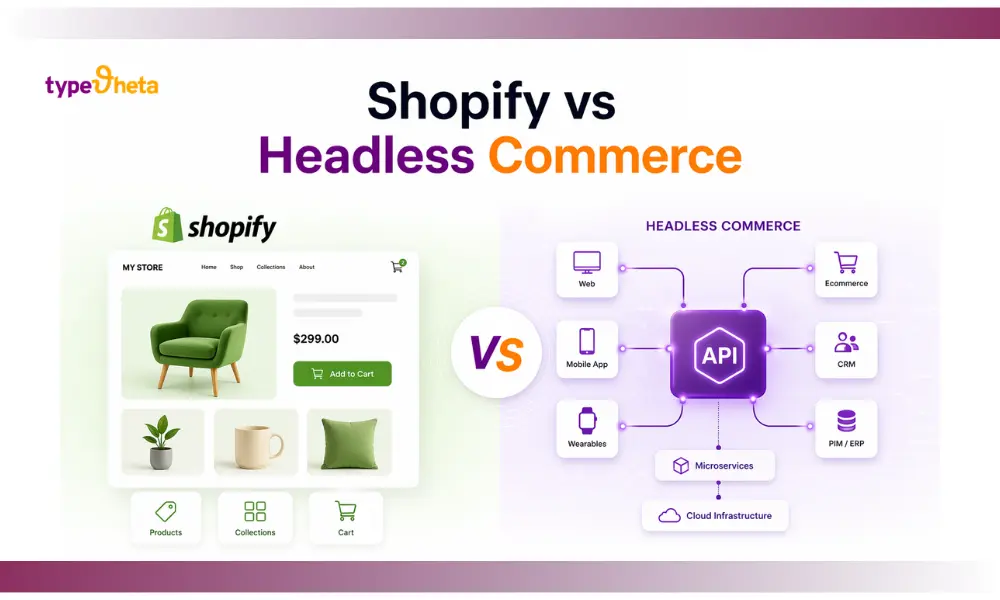
The ecommerce industry is evolving rapidly as businesses search for faster, more flexible, and scalable digital commerce solutions. One of the most common discussions among ecommerce teams, developers, and digital strategists today is “Shopify vs Headless Commerce.” Choosing the right ecommerce architecture plays a critical role in determining how a business delivers online experiences, manages technology infrastructure, and scales its digital operations.
For businesses targeting competitive markets such as the United Kingdom and London, selecting the right ecommerce architecture is even more important. Consumers expect fast websites, seamless checkout experiences, mobile optimisation, and personalised product recommendations. The platform and architecture used behind the scenes directly influence whether a business can meet these expectations.
Understanding Shopify vs Headless Commerce helps companies make informed technology decisions that support long term growth. While Shopify offers a powerful all in one ecommerce platform that simplifies store management, headless commerce introduces a flexible architecture that separates the storefront experience from the backend commerce system.
Both approaches have advantages, limitations, and ideal use cases. This comprehensive guide explains how Shopify vs Headless Commerce works, the differences between traditional and headless ecommerce architecture, their benefits and drawbacks, and how businesses can decide which model best supports their digital commerce strategy.
Understanding the Core Concept of Shopify vs Headless Commerce
Before comparing these two approaches, it is essential to understand what each architecture represents and how it functions in modern ecommerce environments.
What is Shopify Traditional Ecommerce?
Shopify is a fully hosted ecommerce platform designed to help businesses launch and manage online stores without the complexity of building custom infrastructure. It combines the frontend storefront and the backend commerce system within a single platform.
In this traditional architecture, the frontend refers to the visual part of the store that customers interact with, while the backend manages core ecommerce functions such as product catalogues, order processing, payments, and inventory management.
Because Shopify integrates both layers into a single system, businesses can easily manage their online stores using built in themes, apps, and customisation tools. Store owners can modify design elements such as colours, layouts, product pages, and content without extensive development work.
Typical elements that businesses customise within a traditional Shopify store include:
- Colour schemes and visual branding
- Product display layouts
- Page structure and navigation
- Blog layouts and content sections
- Font styles and design components
Shopify also provides professional themes and templates that allow businesses to create attractive storefronts quickly. This simplicity makes the platform extremely popular among startups, growing ecommerce brands, and companies that want to launch stores quickly without building complex systems from scratch.
Another advantage of Shopify is its ability to manage hosting, security, payment processing, and updates automatically. This significantly reduces the technical workload required to run an ecommerce business.
typeTheta is a certified Shopify Partner based in London. We build high-converting Shopify stores tailored to your brand, your customers, and your growth goals. See our Shopify services in London.
What is Headless Commerce?
Headless commerce represents a more modern and flexible approach to ecommerce architecture. In this model, the frontend and backend are separated and communicate through APIs.
The term “headless” refers to removing the traditional frontend layer from the backend commerce engine. In this architecture:
- The frontend represents everything the customer interacts with, such as the website interface, mobile applications, or digital storefronts.
- The backend manages product data, checkout functionality, order management, and inventory systems.
Because the two layers are independent, developers can design completely custom storefront experiences while still using a reliable ecommerce backend.
Headless commerce is often described as API first commerce because all communication between the frontend and backend happens through application programming interfaces. This allows businesses to connect multiple digital experiences to a single commerce engine.
For example, the same backend system could power:
- Websites
- Mobile apps
- Smart devices
- Digital kiosks
- Social commerce integrations
This flexibility allows businesses to deliver highly personalised and innovative shopping experiences across multiple channels.
Not sure which architecture suits your business? As a leading Shopify Agency in London, typeTheta helps UK brands choose, build, and scale the right ecommerce setup – from traditional Shopify stores to fully custom headless builds. Book a free consultation
The Key Difference in Shopify vs Headless Commerce
The primary difference between Shopify vs Headless Commerce lies in how the storefront and backend systems interact.
In a traditional Shopify setup, the frontend and backend operate together as one unified platform. This simplifies development and management but limits flexibility.
In a headless architecture, the frontend and backend operate independently. Developers build the storefront using modern frameworks while connecting it to a commerce backend through APIs.
This separation enables businesses to create highly customised user experiences and integrate advanced technologies such as artificial intelligence, machine learning, and personalisation engines.
For instance, a headless architecture could analyse customer behaviour and automatically display personalised product recommendations across multiple devices in real time.
Headless Commerce Development Stack
When businesses adopt headless commerce using Shopify, they often rely on a development stack designed to support this architecture.
Key components typically include:
Storefront API
This API layer allows developers to access Shopify commerce functionality such as product data, pricing, subscriptions, and checkout systems. It enables custom storefronts to interact directly with the Shopify backend.
Hydrogen
Hydrogen is a development framework designed specifically for building headless Shopify storefronts. It provides preconfigured components and tools that simplify the process of creating custom ecommerce interfaces.
Oxygen
Oxygen is a hosting platform designed to support headless storefronts built using the Hydrogen framework. It provides fast deployment and optimised performance for custom ecommerce experiences.
Together, these tools allow developers to create advanced digital commerce experiences while still benefiting from Shopify’s reliable backend infrastructure.
Advantages of Headless Commerce
Headless commerce has gained significant popularity because it offers several powerful advantages for businesses seeking advanced digital capabilities.
Faster Innovation and Development
Separating the frontend from the backend allows development teams to work independently. Designers and frontend developers can build new user experiences without modifying the backend system. This accelerates innovation and enables faster deployment of new features.
Greater Personalisation
Headless architecture allows businesses to create highly personalised shopping experiences. By integrating analytics tools, artificial intelligence, and behavioural tracking, businesses can deliver tailored product recommendations and dynamic content.
Omnichannel Commerce Capabilities
Headless commerce supports multiple digital channels from a single backend system. Businesses can deliver consistent experiences across websites, mobile apps, marketplaces, and emerging platforms.
Greater Control Over User Experience
Developers have complete control over the design and functionality of the storefront. This allows brands to create unique digital experiences that reflect their identity and differentiate them from competitors.
Improved Performance Potential
Because developers control how the frontend is built, they can optimise performance through techniques such as server side rendering, progressive web applications, and advanced caching strategies.
Studies have shown that companies implementing headless commerce can experience revenue growth due to improved user experiences and expanded product offerings.
Challenges of Headless Commerce
Although headless commerce offers powerful benefits, it also introduces certain challenges that businesses must consider carefully.
Higher Development Costs
Building a custom headless storefront requires significant development resources. Depending on the level of customisation, implementation costs can range from thousands to millions of pounds.
Increased Technical Complexity
Headless systems involve multiple components including APIs, frontend frameworks, hosting infrastructure, and integrations. Managing these systems requires specialised technical expertise.
Ongoing Maintenance Requirements
Because the system is highly customised, businesses must maintain the frontend, integrations, and infrastructure continuously. This often requires dedicated development teams or external technology partners.
For smaller businesses or companies without technical resources, these challenges may outweigh the benefits of headless commerce.
Advantages of Traditional Shopify Commerce
Traditional ecommerce platforms like Shopify also offer significant benefits that make them attractive for many businesses.
Simple and Fast Deployment
Because Shopify includes all necessary ecommerce components in one platform, businesses can launch stores quickly without building custom infrastructure.
Easier Maintenance
All updates, security patches, and feature improvements are managed within a single system. This reduces technical complexity and operational overhead.
Straightforward Troubleshooting
When problems occur, developers only need to analyse one system rather than multiple integrated platforms.
Lower Initial Investment
Compared to headless architecture, traditional ecommerce setups require significantly lower development costs.
These advantages make Shopify particularly suitable for startups, small businesses, and brands that need to launch ecommerce operations quickly.
Limitations of Traditional Ecommerce Architecture
Despite its advantages, traditional ecommerce architecture also has certain limitations.
- Customisation options may be restricted by platform frameworks
- Scaling complex digital experiences can be difficult
- Integrating new technologies may require additional work
- Advanced omnichannel experiences may be harder to implement
For companies seeking highly customised digital experiences or complex technology integrations, these limitations may become significant over time.
Real World Headless Commerce Examples
Many well known global brands have adopted headless commerce architectures to improve performance and scalability.
For example, the ecommerce brand Ruggable implemented a headless architecture to enhance site speed, stability, and user experience. This transition allowed the company to expand into multiple international markets while maintaining strong website performance during high traffic events such as Black Friday.
Similarly, the global audio brand Sennheiser adopted a headless approach to modernise its ecommerce infrastructure. By separating the frontend from the backend, the company was able to launch multiple ecommerce stores across global markets and improve conversion rates.
These examples demonstrate how headless commerce can support large scale ecommerce growth and international expansion.
Choosing Between Shopify vs Headless Commerce
Deciding between Shopify vs Headless Commerce depends on several key business factors.
Businesses considering a headless approach should evaluate questions such as:
- Do we have an internal development team capable of building and maintaining a headless storefront?
- What limitations currently exist in our ecommerce platform?
- How much customisation do we require for our customer experience?
- What is our available technology budget?
- How quickly do we need to launch or upgrade our ecommerce platform?
Understanding these factors helps businesses determine whether the benefits of headless commerce justify the investment required.
Hybrid Commerce: The Emerging Middle Ground
Many companies are now adopting a hybrid approach that combines traditional ecommerce platforms with headless capabilities.
This blended model allows businesses to maintain the reliability and simplicity of Shopify’s backend while developing custom storefront experiences where necessary.
Benefits of Hybrid Commerce
- Faster time to market
- Greater flexibility
- Improved customer experience
- Lower development costs compared to fully headless architecture
This blended approach allows businesses to maintain Shopify’s reliable backend while introducing custom frontend experiences where needed.
The Future of Ecommerce Architecture
The global ecommerce landscape continues to move toward more flexible and modular technology architectures. Businesses are investing in systems that allow them to adapt quickly to changing customer expectations and digital channels.
Industry research suggests that many companies are planning to modernise their commerce architecture to support future growth. As technologies such as artificial intelligence, personalisation engines, and omnichannel retail continue to expand, headless commerce will likely play an increasingly important role in digital commerce strategies.
Emerging Ecommerce Trends
Businesses are increasingly investing in technologies such as:
- Artificial intelligence
- Personalisation engines
- Omnichannel retail systems
- API driven commerce platforms
As customer expectations evolve, headless commerce will likely play a growing role in enterprise ecommerce strategies. However, traditional ecommerce platforms will remain highly relevant due to their simplicity, reliability, and cost effectiveness.
However, traditional ecommerce platforms will remain relevant due to their simplicity, reliability, and cost effectiveness.
Conclusion: Shopify vs Headless Commerce
The debate around Shopify vs Headless Commerce is not simply about choosing one technology over another. Instead, it is about selecting the architecture that best aligns with a company’s business goals, technical capabilities, and growth strategy.
Shopify provides a powerful and user friendly ecommerce platform that enables businesses to launch and manage online stores efficiently. Its integrated architecture simplifies operations and reduces development complexity.
Headless commerce offers unmatched flexibility and customisation, allowing businesses to create advanced digital experiences across multiple channels. While it requires greater technical investment, it can provide significant advantages for enterprise level ecommerce operations.
For many modern businesses, the optimal solution may involve combining both approaches through a hybrid architecture. This strategy allows companies to leverage the strengths of Shopify’s backend infrastructure while delivering innovative customer experiences through headless frontends.
Understanding the differences between Shopify vs Headless Commerce empowers businesses to build ecommerce systems that support long term digital growth and deliver exceptional customer experiences.
Frequently Asked Questions (FAQs)
Why do enterprise brands adopt headless commerce?
Large ecommerce brands adopt headless commerce because it allows them to create highly customised digital experiences, integrate advanced technologies, and scale across multiple markets and channels.
Is headless commerce more expensive?
Yes, headless commerce typically requires higher development investment compared to traditional ecommerce platforms. The cost includes custom development, infrastructure, integrations, and ongoing maintenance.
Can Shopify be used for headless commerce?
Yes, Shopify supports headless commerce through APIs and development frameworks such as Hydrogen. Businesses can build custom storefronts while still using Shopify as the backend commerce engine.
When should a business choose traditional Shopify ecommerce?
Businesses should choose traditional Shopify ecommerce when they need a fast and cost effective way to launch an online store without complex development requirements. It is especially suitable for startups and growing ecommerce brands.